
Habit tracker journal: how to set one up, and when an app is better
A habit tracker in a notebook is the cheapest tracker there is and the one most people abandon fastest. Three layouts that survive, what to write next to the ticks, and where paper loses to an app.
Three layouts that survive past week two
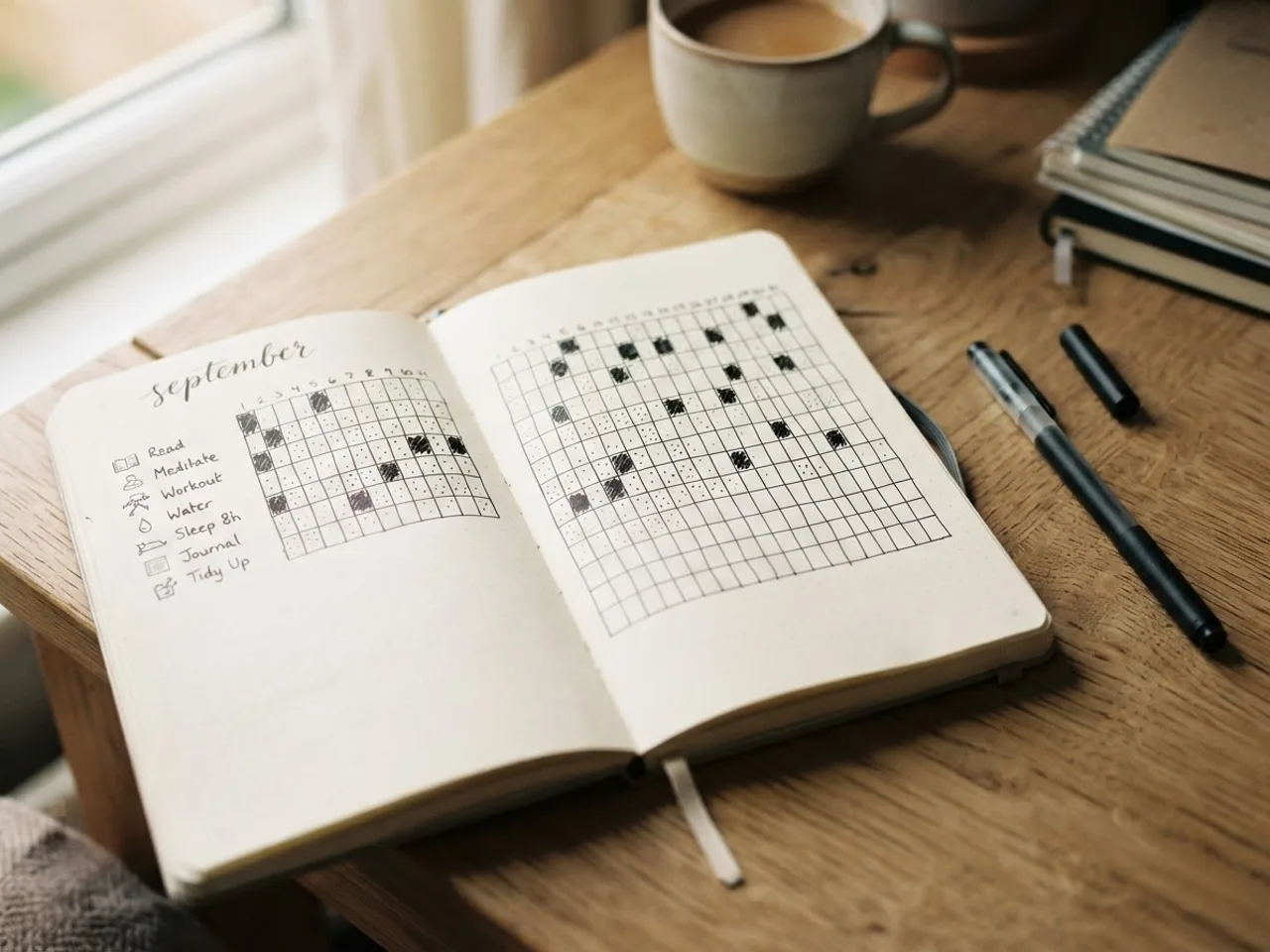
The monthly grid. Habits down the left, 1 to 31 across the top. The classic bullet journal spread. It shows the month’s pattern at a glance and takes ten minutes to draw. The weakness is size: on an A5 page, ten habits is the limit and the boxes are 5 mm.
The weekly strip. Seven boxes per habit, redrawn each week on the weekly spread. Less overview, but it lives next to your week’s tasks, which means you actually open the page. Good for people who already keep a weekly planner.
The single-habit calendar. One habit, a whole month, big boxes. This is the Seinfeld “don’t break the chain” method on paper. It works because the chain is visible from across the room. Use it for the one habit you most want to keep this month.
| Layout | Overview | Effort to set up | Best for |
|---|---|---|---|
| Monthly grid | High | 10 min once a month | 4 to 10 habits with fixed locations |
| Weekly strip | Medium | 2 min a week | People who already journal weekly |
| Single-habit calendar | Low (one habit) | 3 min | The one habit that matters this month |
What to write next to the ticks
A tick says you did it. A word next to the tick says why you did not, and that is where the journal earns its place over an app:
- A one-word reason for a miss. “Tired”, “travel”, “forgot”. After a month, the reasons cluster. Three “forgot” entries mean the cue is wrong. Three “tired” entries mean the habit is scheduled too late.
- A number. Minutes read, kilometres run. Not for every habit, but for the ones where the size of the habit is the thing you are growing.
- A weekly line. One sentence on Sunday: what held, what did not. This is the review most app users never do.
Where paper loses
Be honest about this, or you will draw a beautiful grid and stop using it on day twelve.
- Habits that happen anywhere. “No social media”, “drink water”, “posture”. You are never near the notebook when they happen, so the tick waits until night, and then it waits until tomorrow.
- Streaks. Counting a streak on paper means counting boxes. An app shows the number.
- The year view. Twelve monthly grids in twelve places do not add up to a picture. A per-habit 365-day heatmap does, and it is the single most motivating view in any tracker.
- The 10 pm problem. You are in bed, the notebook is downstairs. The phone is in your hand.
Running both
The arrangement that works for most people who try it: the journal holds the monthly grid for location-bound habits and the Sunday review; the app holds the habits that happen anywhere and keeps the streaks. Virtue does the second half with no account and no subscription, which keeps it as low-friction as the notebook. For the paper half, the printable habit tracker gives you the monthly grid without drawing 310 boxes.

A full page, drawn step by step
If you have a dot-grid notebook, this is the monthly grid in ten minutes. On ruled or blank paper the steps are the same; the boxes are just less even.
- Title line. Month and year, top left. Leave the top right for the total count at the end of the month.
- Habit column. Down the left, one habit per row, two rows of dots apart. Write the two-minute version, not the ambition: “one page”, not “read more”.
- Day columns. Across the top, 1 to 31. On A5 dot grid, one dot per day fits if you use the small boxes; on A6, split the month into two rows of 15 and 16.
- Weekend shading. Lightly shade the Saturday and Sunday columns before you start ticking. It keeps a skipped Sunday from looking like a broken streak later.
- Margin. Leave a half-inch on the right for the one-word reason on missed days.
- The mark. Decide now: a filled box, a cross, a dot. Filled boxes are easiest to read at a distance and they are what every app copies.
The whole grid is drawn once. Ticking takes two seconds a day, which is the number that matters.
The Sunday review, which is why the journal beats the app
An app shows you the pattern. A journal makes you write about it, and the writing is where the adjustment happens. The Sunday review is one line per habit:
- Held all week: leave it, or grow it slightly next week.
- Missed once: fine. Note the reason if there was one.
- Missed three times or more: the habit is wrong, not you. Either the cue is unreliable, the size is too big, or the time of day is wrong. Change one of those, not all three.
- Missed every day: drop it from the tracker for a month. A row of empty boxes teaches you to ignore the page.
Ten minutes on Sunday, in the notebook, next to the grid. People who do this keep tracking; people who only tick tend to stop around week six, when the novelty of the grid wears off and nothing has replaced it.
Trackers that are not grids
The monthly grid is the default, but three other journal layouts suit specific situations:
| Layout | Draws | Best for |
|---|---|---|
| Year in pixels | A 12 by 31 grid, one square per day, coloured by a single measure | One habit or one mood, tracked for a whole year on one page |
| Habit ladder | A vertical list with a running count next to each habit | Counting totals (books read, runs done) rather than daily ticks |
| Chain calendar | A normal month calendar with a line linking consecutive done days | The one habit you are trying to make unbreakable |
The year in pixels is the one that photographs best and the one people abandon fastest, because a full year is a long time to fill one square a day. Start with the monthly grid.
Supplies, and what to ignore
The bullet journal world sells a lot of stationery. For a habit tracker you need a notebook and one pen. Dot grid paper (5 mm) makes straight boxes without a ruler; a Leuchtturm1917 A5 or a cheaper Scribbles That Matter both work, and so does a school exercise book. One black fineliner (0.38 or 0.5) for the grid and the ticks. A single coloured pen if you want the ticks to stand out from the lines.
Ignore washi tape, stencils, stamps and brush pens until the tracker has survived three months. Decorating a page is a different hobby from tracking habits, and it is a well-known way to spend the evening on the tracker instead of the habit.
A month in the journal, honestly described
Week one, the grid is new and the ticks are satisfying. Every habit gets done, partly because the page is watching. Week two, the first misses appear and the one-word reason column starts earning its place: “late”, “travel”, “forgot”. Week three is where the tracker either becomes part of the day or quietly stops: the novelty is gone, the ticks are a chore, and the grid sits closed for two days. If the notebook survives week three it usually survives the year, and the thing that gets it through is the Sunday review, because writing one line about the week reopens the page with a purpose other than ticking. Week four, the totals get written in the margin, next month’s grid gets drawn, and the second month starts with a page that already knows what to expect.
Setting up the first page
- Pick three habits from the habits to track list, all with a fixed time and place.
- Draw the monthly grid, or print it.
- Leave a margin on the right for the one-word reasons.
- Put the notebook where the first habit happens, open to that page.
- On the last day of the month, write the weekly line for the whole month and draw next month’s grid before you close the book.
Frequently asked questions
What is a habit tracker journal?
A page in a notebook, usually a bullet journal, with habits down the side and days across the top, where you fill a box each day you do the habit. It can be a monthly grid, a weekly strip, or a single-habit calendar.
Do I need a special notebook?
No. Dot grid paper makes the boxes easier to draw, but any notebook works. The printable on this site is the same grid without the drawing.
Paper or app?
Paper if your habits happen in one place and you like the ritual. App if your habits happen anywhere and you want a streak and a year view without drawing it. Many people run both.
How many habits fit on a journal page?
Eight to ten in a monthly grid on A5. More than that and the boxes are too small to fill without a fine pen, and the page stops being readable.