
30 day plank challenge: the chart and how to finish it
A 30-day plank chart from 20 seconds to 4 minutes with rest days built in, the three form cues that keep your lower back out of it, and what to do on the days the number feels impossible.
The chart
| Day | Hold | Day | Hold | Day | Hold |
|---|---|---|---|---|---|
| 1 | 20 s | 11 | 60 s | 21 | 2:30 |
| 2 | 20 s | 12 | 60 s | 22 | 2:30 |
| 3 | 30 s | 13 | 75 s | 23 | 3:00 |
| 4 | 30 s | 14 | 90 s | 24 | 3:00 |
| 5 | Rest | 15 | Rest | 25 | Rest |
| 6 | 40 s | 16 | 90 s | 26 | 3:15 |
| 7 | 40 s | 17 | 2:00 | 27 | 3:30 |
| 8 | 45 s | 18 | 2:00 | 28 | 3:45 |
| 9 | 50 s | 19 | 2:15 | 29 | 4:00 |
| 10 | Rest | 20 | Rest | 30 | 4:00 |
Each hold is one set. If you cannot complete the hold with good form, do it as two sets with 30 seconds of rest and write both times down. That still counts.
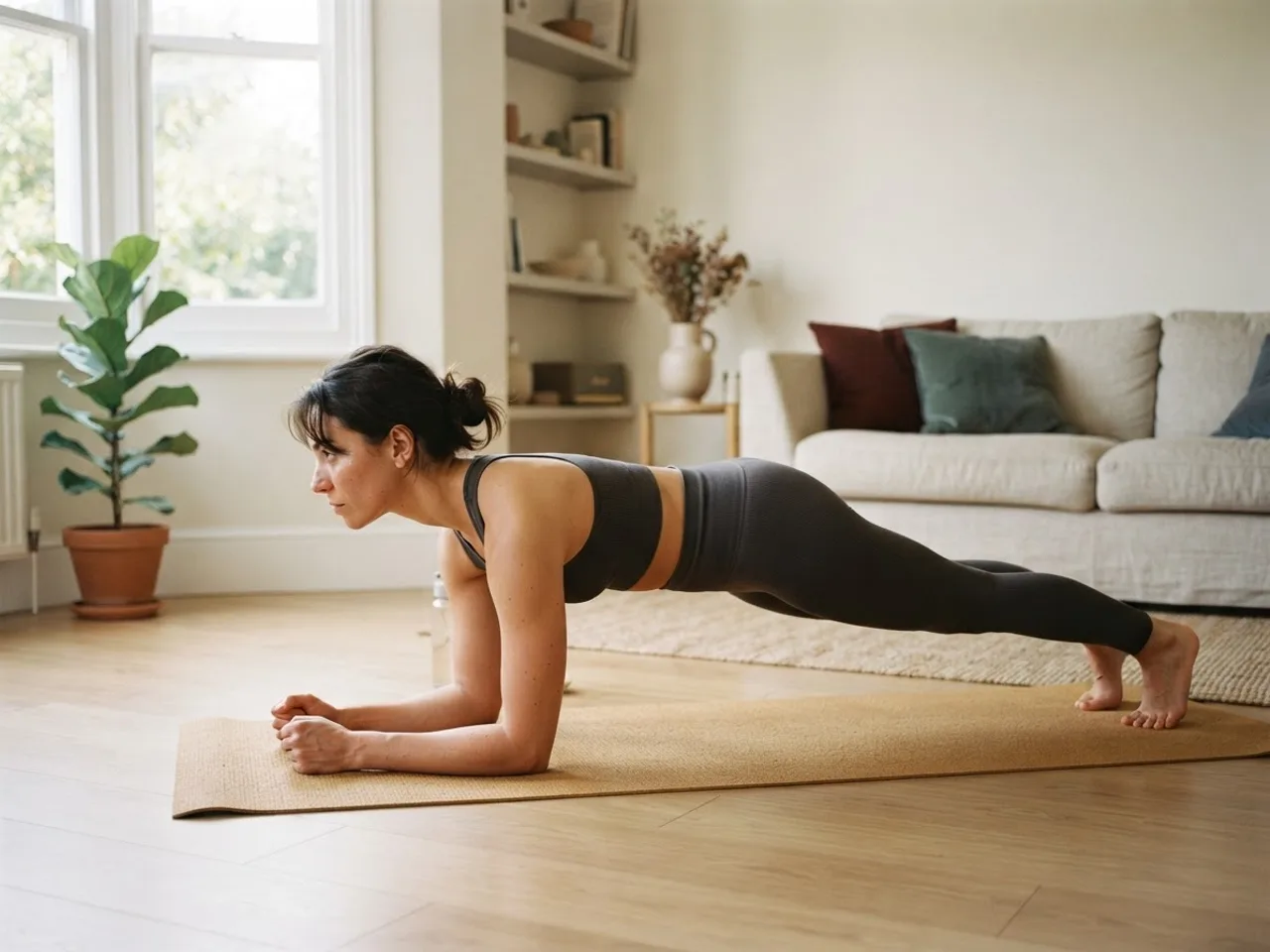
Three form cues that matter
- Squeeze the glutes. This tilts the pelvis and takes the lower back out of the exercise. If your back hurts during a plank, this is nearly always the fix.
- Push the floor away. Elbows under shoulders, forearms pressing down, upper back slightly rounded rather than sagging between the shoulder blades.
- Look at the floor, not ahead. Neck in line with the spine. Looking forward arches the neck and, after a minute, the lower back follows.
If you cannot hold the position with all three, the hold is over. Stop, note the seconds, and that is your number for the day. A 40-second plank with the back arched is worse than a 25-second one done right.
Easier and harder
| Variation | When to use it |
|---|---|
| Knee plank | Cannot hold 20 s with form on day 1. Run the chart on knees, then again on toes |
| Incline plank (hands on a bench) | Wrist or shoulder issues |
| Standard forearm plank | The chart |
| Feet elevated | Chart feels easy from day 15 |
| Single-leg lifts, alternating | Days 26 to 30 if 4 minutes is not the limit |
| Side plank, same times | Add from day 11 for obliques; count as a second habit |
The days you will want to quit
Day 8 (the first 45 seconds), day 17 (the first two minutes) and day 23 (three minutes) are where most people stop. The jump is bigger on those days than the ones around them. Two things help: do the hold first thing in the morning before you have time to negotiate, and split it into two sets if needed. Two sets of 90 seconds on day 17 is a completed day.
Why a plank and not crunches
A plank trains the core to do its actual job, which is holding the spine still while the limbs move. Crunches train it to flex, which the spine does plenty of already. For most people the plank carries over to lifting, running posture and back pain in a way that sit-ups do not, and it is safer for the lower back when done with the three cues above. It is also silent, needs no equipment and fits in a hotel room, which is why it is the most common 30-day challenge and the most finished.
What a plank will not do is change how your midsection looks in 30 days. The muscles get stronger; body fat is decided elsewhere. Anyone promising a visible six-pack from a plank chart is selling the chart.
Breathing, and the two mistakes everyone makes
Holding the breath. The urge is to brace and stop breathing, which raises blood pressure and makes the hold feel twice as long. Breathe normally, slowly, through the nose. If you cannot talk, you are bracing too hard.
Watching the clock. Staring at the phone timer makes the last twenty seconds an eternity. Set the timer, put the phone face down, count breaths instead. A calm breath is roughly four seconds; a two-minute plank is thirty breaths.
Warm-up, and when to skip a day
The plank needs no warm-up beyond thirty seconds of movement: a few cat-cows, a couple of slow squats. Doing it cold first thing in the morning is fine for holds under a minute; past that, the short warm-up prevents the lower back from taking the load before the core is awake.
Skip the day, and repeat it tomorrow, if you have sharp lower back pain (not muscle burn), shoulder or wrist pain that changes your form, or you are ill. Muscle soreness the day after a new jump in time is normal and not a reason to skip.
After day 30: keeping the strength
The chart ends at four minutes, which is well past the point of usefulness. Research on core endurance suggests that holds beyond about two minutes add little; beyond that, add difficulty instead of time. The maintenance version is three holds a week of 60 to 90 seconds with a harder variation: feet elevated, one leg lifted, or a slow side plank on each side. Log it in the tracker as a normal habit, three times a week, and the 30 days become a base rather than an event.
A chart for people starting from zero
If day one’s 20 seconds is not possible with the three cues, this is the same 30 days on the knees, ending at two minutes, after which you start the main chart:
| Days | Hold (knees) |
|---|---|
| 1 to 5 | 15 s, 15 s, 20 s, 20 s, rest |
| 6 to 10 | 25 s, 25 s, 30 s, 35 s, rest |
| 11 to 15 | 40 s, 45 s, 50 s, 60 s, rest |
| 16 to 20 | 60 s, 70 s, 80 s, 90 s, rest |
| 21 to 25 | 90 s, 100 s, 110 s, 2:00, rest |
| 26 to 30 | 2:00, 2:00 then 20 s on toes, 30 s toes, 40 s toes, rest |
Nobody is watching. The knee version done with a straight line from head to knees is a real plank.
Tracking the seconds so the chart means something
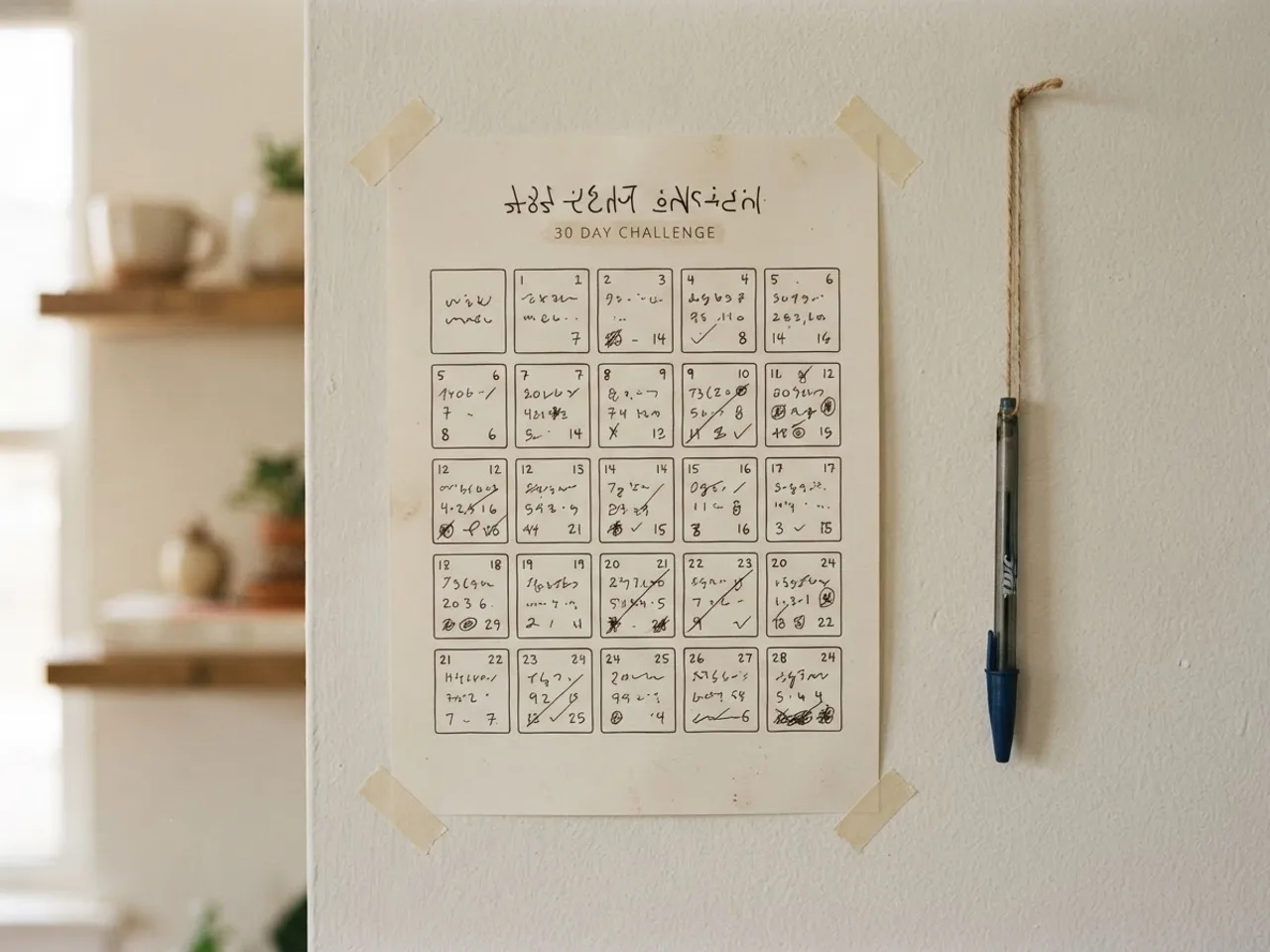
The chart tells you what to attempt; the log tells you what happened. Keep both. The simplest log is the printed sheet with one row for the plank and the seconds written into each day’s box, which doubles as the tick. In an app, the habit is “Plank” and the tick is the seconds being done; put the number in the description or a note.
Two things to look at after ten days. First, the gap between the chart and your actual hold. If you are consistently five to ten seconds short, that is normal; keep following the chart. If you are consistently thirty seconds short, drop back three days and continue from there. Second, the days of the week you miss. Most people miss the same weekday every week, usually the one with the early start or the late finish. Move the plank to the evening on that day, or accept that day as the rest day and shift the chart by one.
Variations for the last week, if four minutes is not the limit
Some people reach day 23 and find three minutes easy. Adding time past that point does not add much; adding difficulty does. In the last week, swap the timed hold for: 60 seconds standard, then 30 seconds with the right leg lifted, 30 with the left, then 60 seconds standard again. Or 90 seconds with the feet on a chair. Or three sets of 45 seconds of side plank per side. Write what you did in the box; the chart is a floor, not a ceiling.
Tracking the 30 days
This is a challenge where the tracker matters more than usual, because the number changes daily and the point is to see the line go up. On paper: the printable tracker with one row for the plank and the seconds written in each box. In an app: one habit called “Plank”, tick daily, and keep the seconds in the notes or on the chart above. A 30-day block of ticks is the whole story. After day 30, keep the plank as a habit at whatever hold you can do in one set, three times a week. That is how the longer challenges get their base.
Frequently asked questions
Is a 4-minute plank at the end of 30 days realistic?
For most people who start around 20 to 30 seconds, yes, if the increases are gradual and there are rest days. If you cannot hold 20 seconds with good form on day one, start with the knee variation and run the chart twice.
Should I do the plank every day?
The chart has a rest day every fifth day. Muscles adapt on rest days, and a daily 3-minute plank with no rest is how people end up with a sore lower back and a quit on day 22.
What if I miss a day?
Repeat the last day you completed. Do not skip ahead and do not restart. Missing one day changes nothing; missing a week means going back three days on the chart.
How do I track it?
Tick the day and write the seconds. Paper works well for this one because the chart and the log can be the same sheet. The printable tracker gives you the month; the seconds go in the box.