
75 Hard alternatives: 6 challenges that build habits without the burnout
75 Hard works for a small number of people and injures or burns out the rest. These six alternatives keep the structure that makes it work, a fixed set of daily rules and a visible count, and drop the parts that make most people quit by day 20.
What 75 Hard gets right
Three things, and they are worth keeping in any alternative:

- Fixed rules, no negotiation. You do not decide each morning whether today is a workout day. The decision was made once.
- A visible count. Day 41 means something. The number does the motivating.
- A reading rule. It is the one rule that has nothing to do with the body, and it is the one people say changed them.
What it gets wrong is the dose (two workouts a day, indefinitely) and the reset (one missed rule erases everything). The alternatives below keep the three good parts and fix the two bad ones.
The six alternatives
| Challenge | Days | Daily rules | Rest days | Miss a day? |
|---|---|---|---|---|
| 75 Soft | 75 | 1 workout, eat well, 3 L water, 10 pages | 1 a week | Keep going |
| 75 Medium | 75 | 1 workout of 45 min, diet with one cheat meal a week, 3 L water, 10 pages, photo | 1 a week | Keep going |
| 30 Hard | 30 | The original five rules | None | Restart |
| 66-Day Habit | 66 | 3 habits of your choice | Built in | Never miss twice |
| Winter Arc | ~90 (Oct to Dec) | Self-chosen: usually workout, sleep, no alcohol, a skill | Flexible | Keep going |
| Custom 75 | 75 | 4 rules you pick, 1 must be non-physical | 1 a week | Keep going |
75 Soft is where most people should start. It keeps the four rules that matter, adds a rest day, and drops the restart. The reading rule stays.
75 Medium sits between the two: the 45-minute workout is mandatory, the diet is strict apart from one planned cheat meal, and the progress photo comes back. For people who found Soft too soft.
30 Hard is the original rules for 30 days. The dose is the same, the horizon is a third. If you want to know what the full thing feels like without committing the whole autumn, this is the test.
The 66-day habit challenge is the version backed by the research on habit formation rather than by a podcast. Pick three habits, do them daily for 66 days, never miss two days in a row. The calculator gives the milestone dates.
Winter Arc is the seasonal one: from October to the end of the year, a self-chosen set of rules aimed at arriving in January already in motion instead of starting then. Rules vary; the common core is a daily workout, an earlier bedtime and no alcohol on weekdays.
Custom 75 is the honest version of all of this: 75 days, four rules you choose, at least one non-physical (reading, a skill, no phone after 9), one rest day a week, no restart. The structure of 75 Hard with a dose you can survive.
Choosing the dose
The rule that predicts whether you finish is not how hard the challenge is, it is whether you can do the rules on your worst day. Sick, travelling, up with a baby: can you still read ten pages and drink the water? If the answer is no for more than one rule, the challenge is too big and you will quit at the first bad week, which is usually week three.
What the research says about challenge length
The 75-day number is not from research; it is a round figure that felt serious. The closest thing to evidence is the 2009 University College London study on habit formation, where the median time for a new daily behaviour to feel automatic was 66 days, with a range from 18 to 254. That supports two things: a two-month horizon is sensible, and the exact day count matters less than the daily repetition.
It also undermines the restart rule. The same study found that missing a single day made no measurable difference to whether the habit formed. A challenge that sends you back to day one after one missed rule is punishing the one mistake the research says is harmless. Every alternative above drops the restart, and that is the change most responsible for people finishing.
Picking rules that fit a life
The failure pattern in 75 Hard is not laziness. It is a rule set designed for someone with two free hours a day and no dependents. Building your own rule set, the constraints that predict finishing are:
| Constraint | Why |
|---|---|
| Every rule doable on your worst day | Sick, travelling, up at night with a child. If not, you will quit at week three |
| At most one rule that needs equipment or a place | The gym closes, it rains, the pool is full |
| One rule that has nothing to do with the body | Reading, a skill, no phone after nine. It is the rule people say changed them |
| A rest day built in | Not optional after 40 |
| A total daily time you can name | If the rules add up to three hours, they add up to quitting |
A rule set that passes all five looks something like: 30 minutes of movement (any kind), no alcohol on weekdays, ten pages of a book, phone off by 9:30, water with every meal. Roughly an hour a day, most of it things you were half doing anyway.
What to do on day 76
The part no challenge tells you. A challenge ends and the structure vanishes with it, which is why so many people are back to baseline a month later. The fix is to decide, before the last day, which two or three rules continue as ordinary habits at a smaller dose. Ten pages a day becomes five. The daily workout becomes four a week. The rules go from a challenge board into a normal tracker, with no end date, and the streak simply keeps counting.
A four-week starter that leads into any of them
If you have never finished a challenge, do not start with 75 days of anything. Four weeks with three rules, tracked daily, is the on-ramp:
| Week | Rules |
|---|---|
| 1 | Ten pages of reading, water with every meal |
| 2 | Add 20 minutes of any movement, five days |
| 3 | Add phone off by 10 pm |
| 4 | Same three, no changes. Finish clean |
Four weeks of ticks is enough evidence that the tracking works and the rules fit. Then pick the 75-day variant whose rules you could already do on your worst week.
Tracking a challenge in an app versus on paper
A challenge with four or five rules is exactly the case a habit tracker is built for, and it exposes the difference between the two ways of tracking.
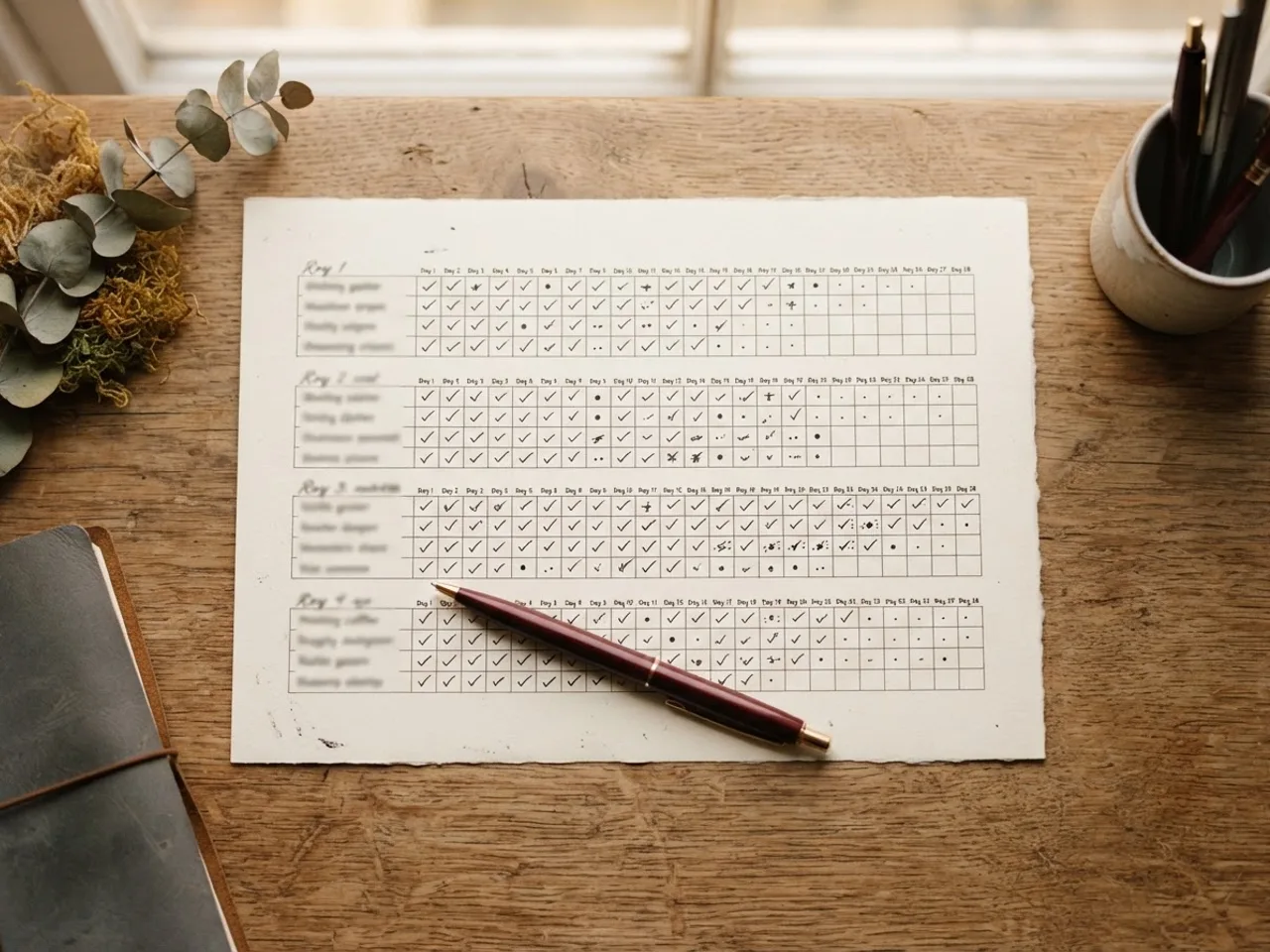
On paper, the challenge sheet is a single page: rules down the side, days across, and it goes on the wall where you will see it at breakfast. That visibility is the paper advantage and it is real. The disadvantage is the evening rules: “read ten pages” gets ticked at 11 pm, when the sheet is downstairs.
In an app, each rule is a habit, so the daily view is the challenge board and the streak per rule shows which one is slipping before the whole thing breaks. Reminders cover the evening rules. The disadvantage is that the phone is also where the distractions live, and a challenge that includes “no phone after nine” is awkward to tick on the phone after nine. Tick it in the morning for the night before; the day count is what matters, not the timestamp.
Either way, the single thing that predicts finishing is looking at the tracker every day. Put it where that happens.
Tracking it
One row per rule, tick daily, count the days. That is the whole system, and it is exactly what a habit tracker is. Put the rules in Virtue as separate habits and the home screen becomes the challenge board; the streak per habit shows which rule is slipping before it breaks. For a paper board, print the month from the printable tracker with one row per rule.
Frequently asked questions
What is 75 Hard?
A 75-day challenge by Andy Frisella with five daily rules: two 45-minute workouts, one outdoors; follow a diet with no alcohol or cheat meals; drink a gallon of water; read 10 pages of non-fiction; take a progress photo. Miss any rule and you start over from day one.
Why do people look for an alternative?
Two workouts a day for 75 days is more than most bodies and schedules can take, and the restart rule turns one bad day into a lost month. The structure is good; the dose is the problem.
What is 75 Soft?
The most popular alternative: one 45-minute workout a day with one rest day a week, eat well with alcohol only on social occasions, three litres of water, ten pages of reading. No restart rule.
How do I track a 75-day challenge?
One row per rule in a tracker, tick each daily. The count of days is the challenge; the days since calculator shows it, and the 66-day calculator marks the milestones.